


Reflections on this year’s Village Hall Advisor Conference
Our Sussex Senior Community Buildings Adviser, Angela Milligan, and Project Support & Communications Officer, Finlay Etherington, joined village hall advisers from across England in Staffordshire last week for a one-of-a-kind networking and training conference hosted by ACRE (Action with Communities in Rural England), the largest gathering of village hall advisers anywhere in the country.
The conference brings together 38 ACRE network member organisations, one for each county of England, each with its own local village hall advisory service and whose advisers work to provide local volunteers with the support needed to keep their community building up and running.
Here, Angela and Finlay reflect on the event:
Angela: This is my fourth village hall adviser conference and every time there’s something new to take away and share with Sussex’s 350 plus village and community halls and the army of volunteers who run them.
Most village hall advisers are the only person in their organisation working with community buildings (I am fortunate to have Fin working with me!), so having a chance to network with other advisers is always fruitful and reassuring, and relationships built during these conferences continue during the year. Advising community buildings requires a lot of technical knowledge and you get to know who has a particular specialism or interest and could help if a hall asks a question, you’ve never come across before – which still happens after 5 years of doing advice work and 3 years being a hall trustee before that.
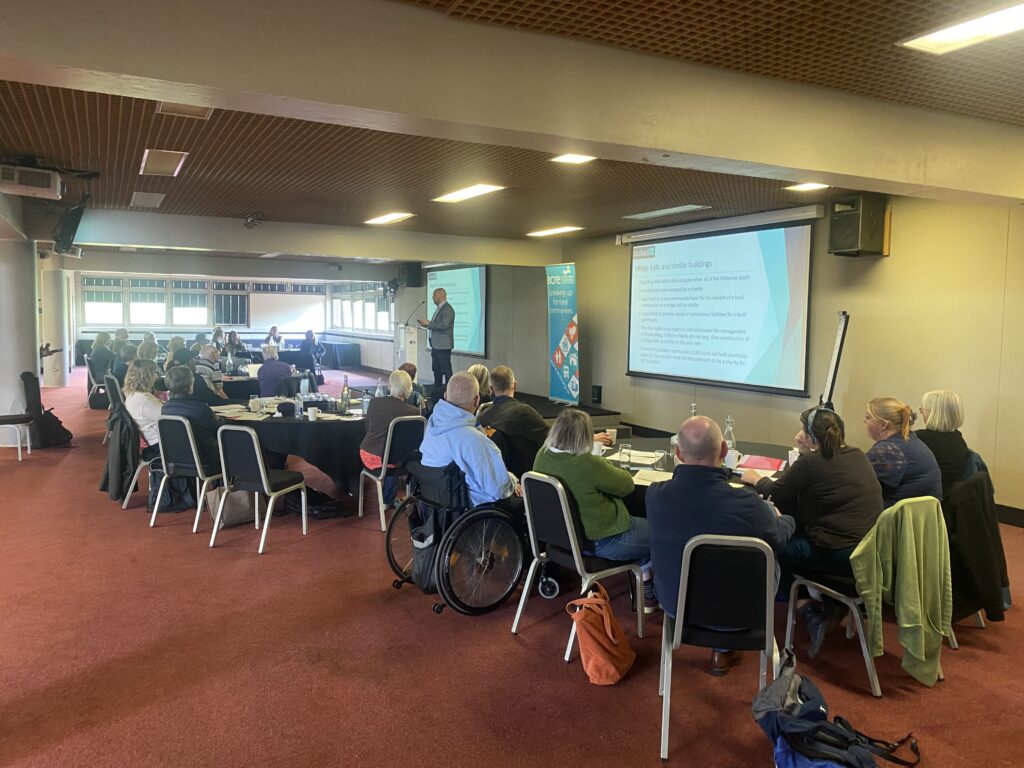
Finlay: Do you know your ancillary purpose trading from your trading subsidiaries? Me neither. This was my first village hall adviser conference, and this is what it was all about – the exchange of knowledge and ideas. I saw myself as a sponge, absorbing as much of this world as I could within the day and a half we had to mingle with the country’s top experts on community buildings. I think the thing that most struck me was the depth of knowledge needed to advise on these matters, and the technical jargon with which volunteers are presented with and must navigate through. So, I was glad to be under Angela’s wing for this! Towards the end of the first day, I did manage to pull some of the advisers, deep in discussion about transferring a hall to a CIO (or if robot hoovers are to take over), for a few games of pool. I’m going to hand back over to Angela now to cover the most pressing issues we covered.
Angela: What struck me this year, as in previous years, is just how much volunteer management committees running halls have to get to grips with. We had sessions on VAT, charity trading, alcohol licensing, food hygiene and insurance, each one of which has its own rules and regulations and requirements that committees need to meet, and that’s just the tip of the iceberg. Keeping abreast of regulatory changes, as well as new legislation such as Martyn’s Law and Simpler Recycling requirements, and providing clear, straightforward guidance for advisers and for halls is a major focus for AirS and ACRE. There is currently ongoing updating of the 40 plus ACRE village hall information sheets, involving the whole network. This is a major effort but it’s essential to ensure that all our guidance is reliable, relevant and comprehensive whilst remaining accessible to time-short hall volunteers.
Every county adviser feeds up issues and concerns arising in their own county to ACRE so that ACRE can consider what can be done and whether to campaign for legislative or regulatory change.
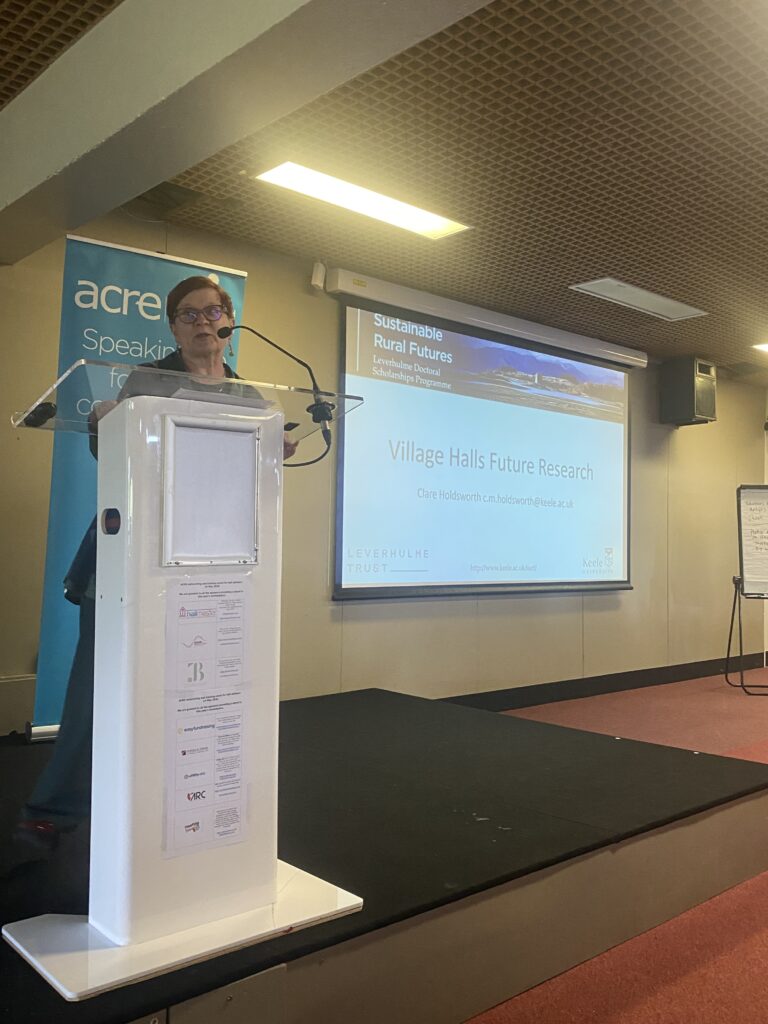
At this year’s conference, ACRE’s policy adviser, Patrick Mahon , led a discussion about issues currently affecting halls. ACRE is already involved in work around banking problems experienced by small charities through the Charity Finance Group, the most recent cases being Lloyds Bank unilaterally closing village hall accounts, leaving them without a bank account. One plan is to develop a list of banks that are small charity friendly. The availability of local Post Offices to bank cash is also potentially an issue as Post Offices close or reduce their hours.
Another area of concern is the cost of heating oil, which rural halls not on the gas grid often depend on. There is no price cap on heating oil for households or businesses, unlike gas, and ACRE is raising this inequitable treatment of rural residents, as well as pointing to the impact on community buildings, which run on very tight budgets.
Transition away from oil is one answer in the longer term and a replacement for the DEFRA Platinum Jubilee Village Hall Grant Fund which ended in March 2026 would help halls with the adoption of energy-saving measures and renewables. An extension of zero VAT rating on energy-saving materials beyond March 2027 is also a priority as this will impact on many halls as they try to reduce their energy costs and their carbon footprints.
Other issues discussed were VAT on fuel and energy and inconsistency in the way utility companies treat village halls for VAT, which is an ongoing bugbear for many halls, and how local councils treat waste collection from village halls. We also touched on possible opportunities for halls such as the new NHS 10 year plan with its focus on prevention, healthy living and local provision, all of which could be supported through activities and services held in community buildings.
As we saw during our visits in Village Halls Week, community buildings are more than just places to hire – they have the power to boost health and well-being, both mental and physical, bring people together, build community cohesion, overcome isolation and improve the lives of those living in rural and other communities. At AirS we look forward to continuing to work with the ACRE network to seek progress on these priorities, whilst continuing our support for the volunteers across Sussex who work so tirelessly to keep the doors of their halls open.
 Twitter
 Facebook